Making research expertise easier to find.
Rlync helps you find the right people by what they actually work on, in any discipline and at any stage of their career.
Currently working with universities and other organisations on pilots.
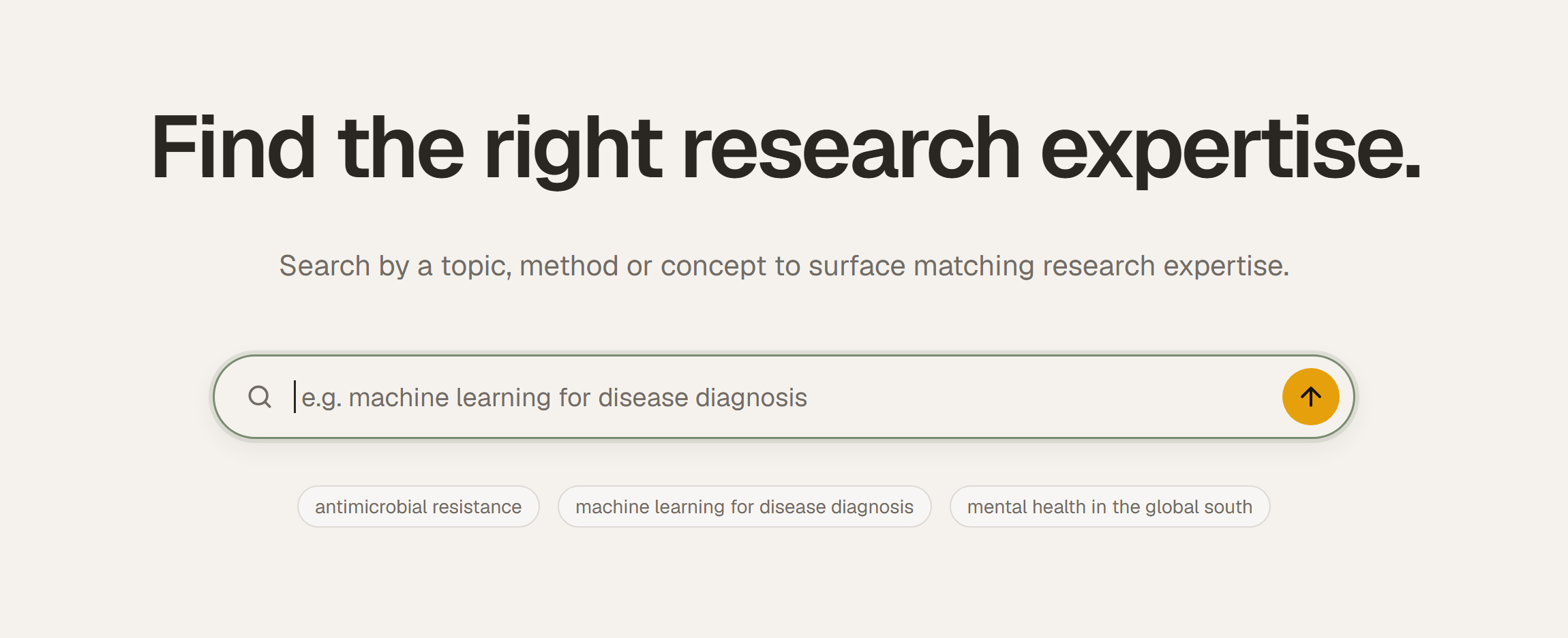 See how it works: machine learning for disease diagnosis
There's no shortage of expertise, only of ways to find it.
Finding the right people outside your own network is slow and difficult.
-
Depth
Researchers visible across all career stages, disciplines and regions.
Only those in your network you already know, or the same high-profile researchers.
-
Speed
Seconds to find people ranked by how closely their work matches your query.
Slow manual discovery. Days spent searching papers and web profiles to find the right researchers.
-
Explainability
The exact papers and content that made someone relevant, linked back to the source.
Recommendations without clear evidence. A name and a title, or entire profiles returned.
Who it's for
Anyone looking for research expertise
An R&D team looking for a collaborator, a conference organiser looking for speakers, journalists needing an expert, a policy team with a question, or a funder or publisher looking for relevant expertise.
Researchers
Discover new perspectives and potential collaborators across disciplines and institutions. Get noticed based on the work you actually do.
Universities
Pull together the right team for a funding bid, answer an outside enquiry, or quickly find people in your institution with relevant expertise and skills.
How it works
Rlync searches across the research record to find people whose work is relevant to what you're looking for, even when they describe their work differently.
-
1. Search in your own words
Type a topic, method, problem or question. A search for “machine learning for disease diagnosis” returns a ranked list of researchers, each with a summary of the work that made them relevant.
You can narrow results by institution, output type, author position, industry collaborators and more, and export them.
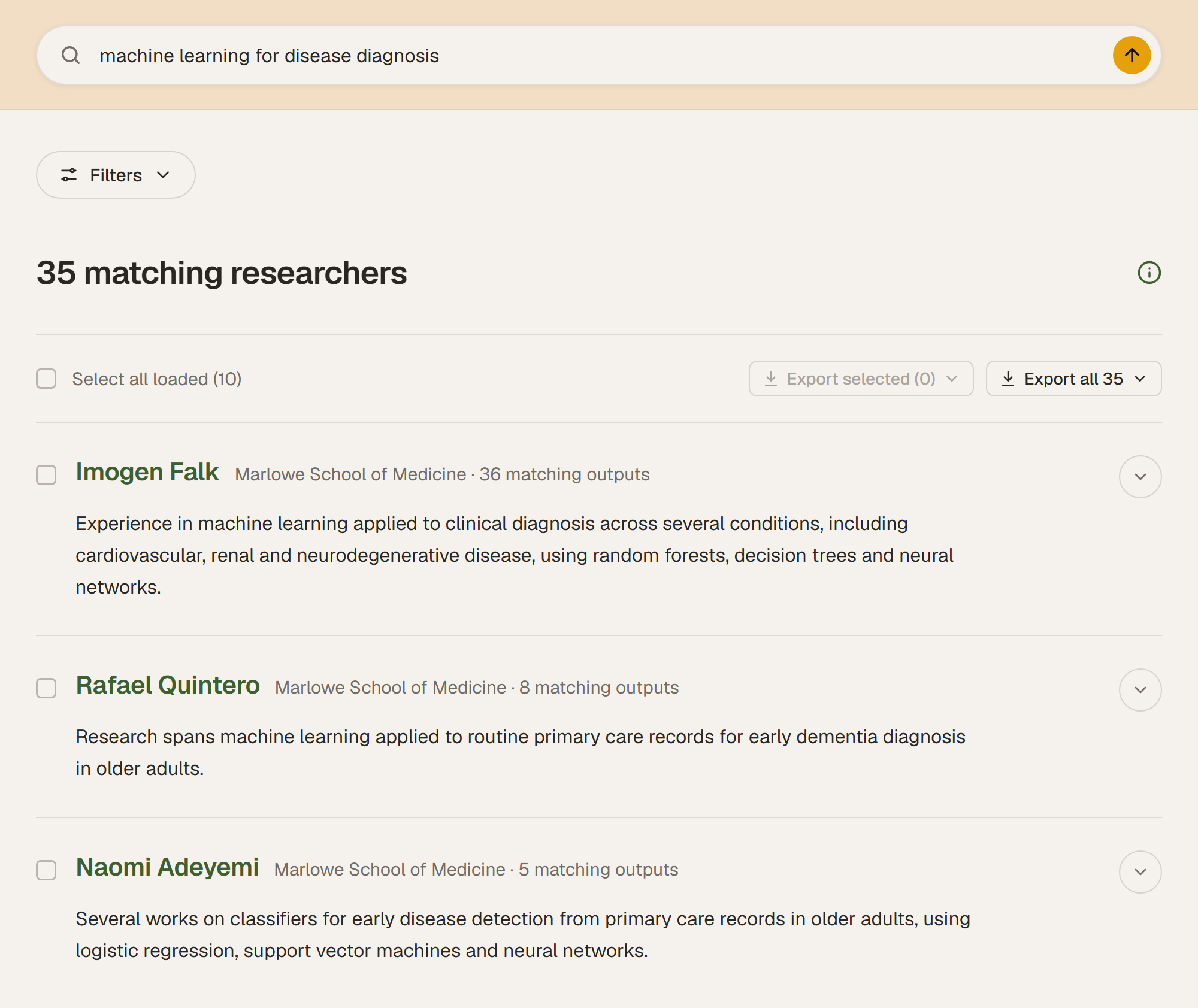
Illustrative example with sample data.
-
2. See why someone is relevant
Open a result to see which papers matched your search, with a link back to the original source. You can see why a person surfaced, down to the exact sentence.
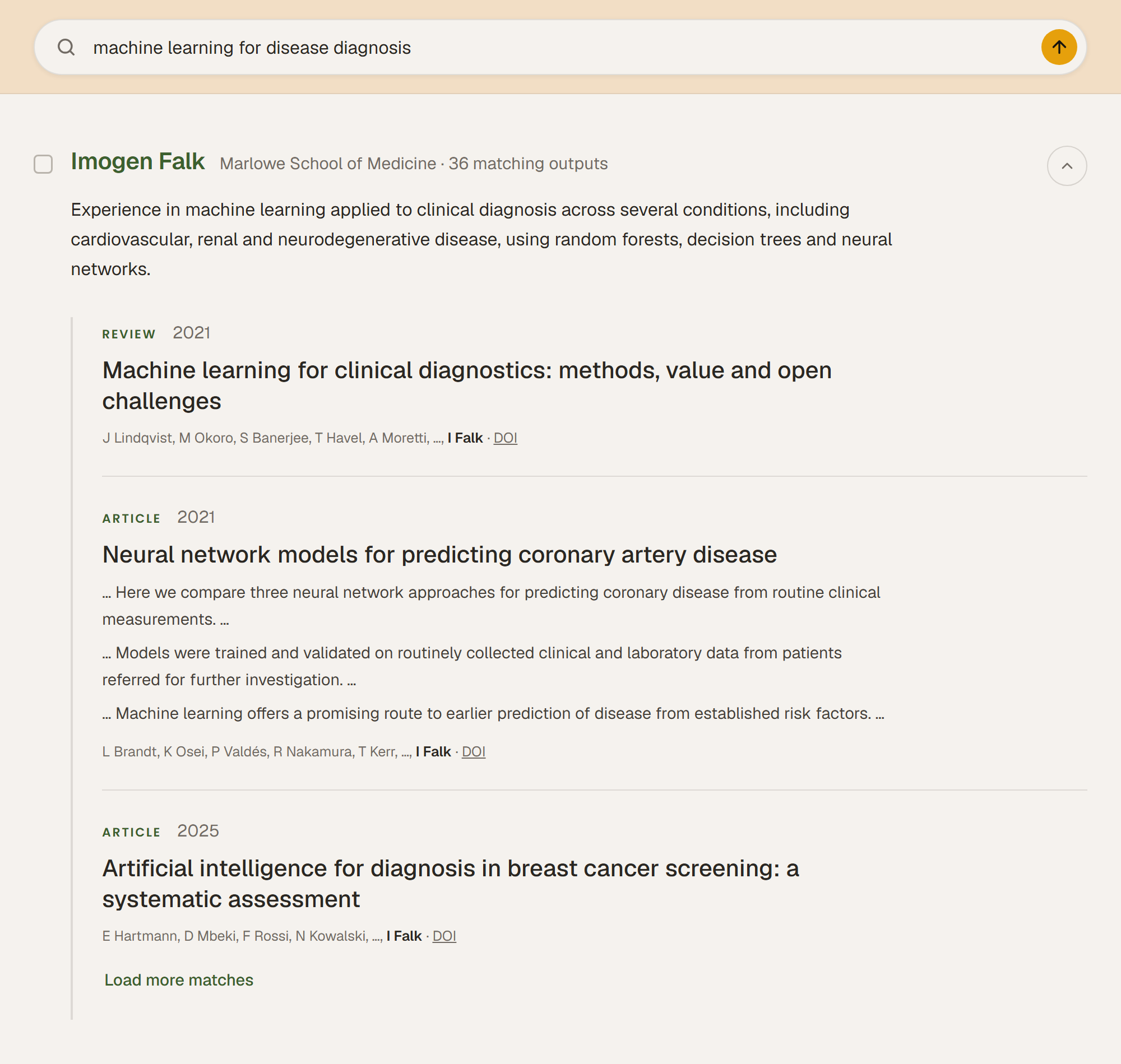
Illustrative example with sample data.
-
3. Match expertise to opportunityComing soon
The same technology can match opportunities, questions and problems to researchers with relevant expertise, from funding calls and roles to policy questions and industry challenges.
Beyond General-Purpose AI
Rlync found 3.5× as many researchers as the best AI assistant, Claude’s Deep Research mode, on a cross-disciplinary query.
From our test with Brighton and Sussex Medical School
We asked leading AI assistants to identify researchers at Brighton and Sussex Medical School working on ‘machine learning for disease diagnosis’. Even after nearly eight minutes of deep research, the best-performing assistant found just 29% of the researchers in Rlync’s defined set of clear matches.

From our King's College London pilot of an earlier version of Rlync.
“I needed to identify researchers for an interdisciplinary project. I remember this taking days of searching through various research profiles, but I found the right people in seconds using Rlync.”
The team
-

Dr Gemma Archer (LinkedIn profile, opens in new tab)
Co-founder & CEO
Gemma leads Rlync and builds the platform. She's an epidemiologist with over ten years' experience working with large-scale health data, and trained in venture building as an Innovation Fellow at Zinc Ventures.
-

Dr Benjamin Elsworth (LinkedIn profile, opens in new tab)
Co-founder & Technical Advisor
Ben co-founded Rlync with Gemma and advises on the technical side. He co-built OpenGWAS, one of the world's largest search engines for genetic association data, and is Lead Data Engineer at Our Future Health.
Rlync is a social impact venture aiming to democratise researcher discovery and access to opportunity.
With support from:
- Innovate UK · Unlocking Potential Award
- King's College London · Ideas Factory Entrepreneurship Award
- University of Bristol · Jean Golding Institute Data Science Seed Award